
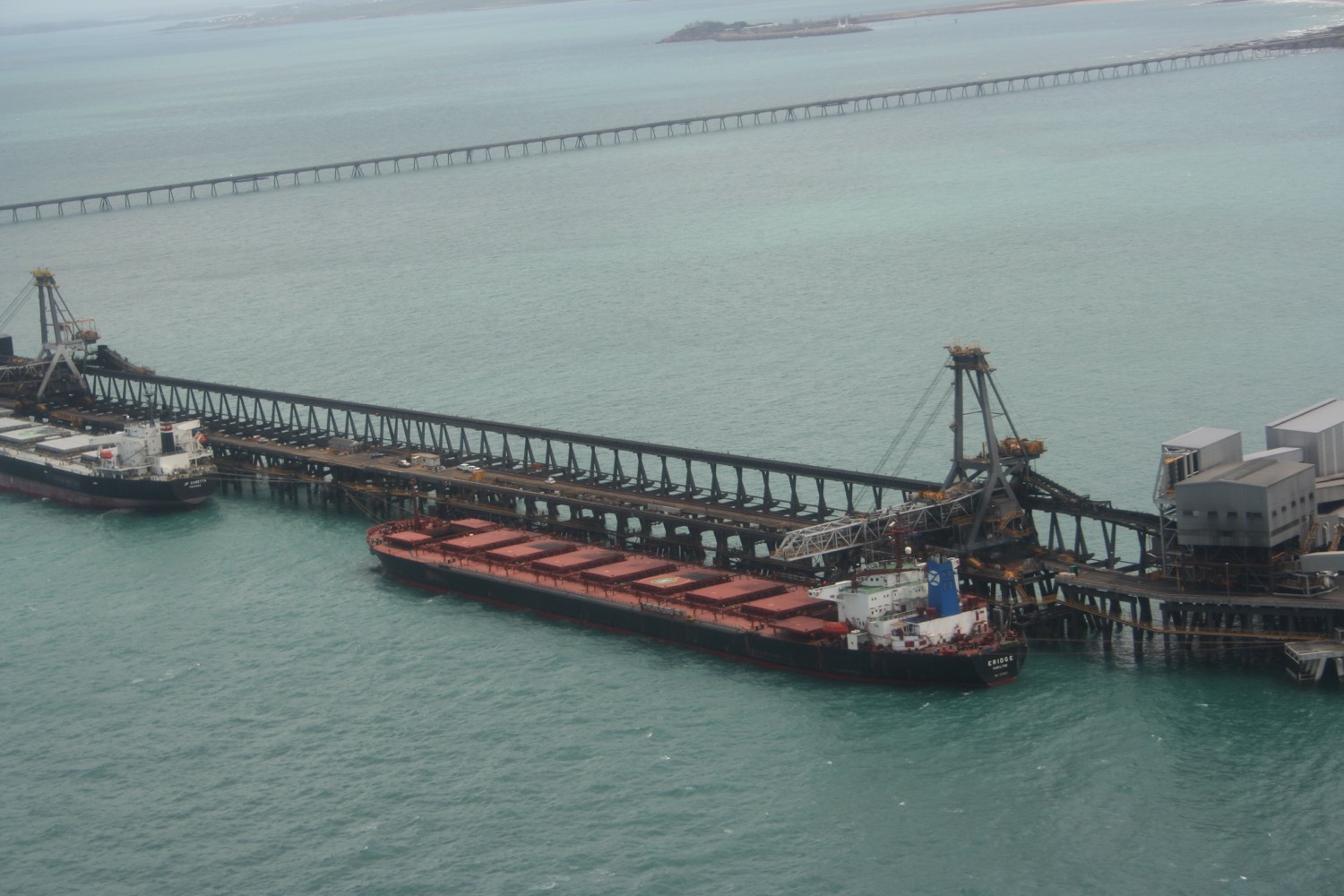
Queensland's coal royalty tops out at 40 per cent. That number gets quoted a lot, usually by the Queensland Resources Council (QRC), the industry's own lobby group, which has every incentive to make the rate sound as punishing as possible. So start with the more useful question: compared to what?
The tiers, plainly
Queensland's royalty isn't a flat rate. It's six progressive bands, each applying only to the slice of price that falls inside it: 7 per cent on the first A$100 a tonne, 12.5 per cent from A$100–150, 15 per cent from A$150–175, 20 per cent from A$175–225, 30 per cent from A$225–300, and 40 per cent above A$300. The bottom band — 7 per cent — is unchanged from before 2022; nobody is arguing that part is confiscatory. What changed on 1 July 2022, at the top of a coal price boom, was everything above A$150 a tonne, and that's the part carrying the argument.[2][3]
QRC's own framing: the 40 per cent top tier is "nearly four times" the lobby group's cited global average of 12.9 per cent, and the second-highest tier, 30 per cent, "exceeds the maximum royalty rate applied by every other major coal-producing jurisdiction." Those are QRC's numbers, from QRC's own comparison, and they should be read as advocacy — a trade body publishing the framing most useful to its members — not as a neutral international survey. The desk hasn't independently verified the 12.9 per cent global-average figure or QRC's claimed sector-contraction numbers (a $9.6 billion sector decline and 24 per cent employment drop in 2024–25) against government data, and readers should treat those specific figures as the industry's own claim until they're checked against an independent source. What can be checked directly — because it's each government's own published rate — is the comparison itself.[1]
What the comparable jurisdictions actually charge
New South Wales, the obvious next-door comparator, raised its own coal royalties from July 2024 — to 10.8 per cent for open-cut mining, 9.8 per cent underground, 8.8 per cent for deep underground, up from 8.2/7.2/6.2 per cent. That's a real increase, and it undercuts any claim that only Queensland is reaching for more coal revenue. It is also, at its highest, less than a third of Queensland's top marginal rate.[4][5]
The United States cut its federal coal royalty from 12.5 per cent to 7 per cent through 2034, under the reconciliation package signed into law in 2025 — a rate cut, not a rise, running in the opposite direction to both Australian states. States add their own severance tax on top: Wyoming, the country's largest coal-producing state, charges 6 per cent on surface-mined coal and 3.75 per cent underground, and cut both further in 2026. Even stacking the current 7 per cent federal royalty and Wyoming's 6 per cent state severance tax — not a precise apples-to-apples sum, since the two taxes use slightly different valuation bases — the combined take on a Powder River Basin tonne lands somewhere near 13 per cent. That's roughly a third of Queensland's top tier, and the US number is falling, not rising.[6]
British Columbia doesn't use a price-tier royalty at all. Coal miners there pay a 2 per cent Net Current Proceeds tax while they're still recovering the capital they spent building the mine, and only move to a 13 per cent Net Revenue Tax once that capital account is paid off. The mechanism is the tell: BC's system is built around whether the mine has actually earned back its investment. Queensland's is built around the price on the day the coal is weighed, full stop.[7]
This piece leaves out Colombia and Indonesia — both real coal exporters, neither carrying an investment-grade sovereign rating in the range this comparison is trying to hold constant, which makes their royalty settings a different conversation about a different kind of risk.
Why the design is the real story
Line the top rates up and Queensland is the outlier by a wide margin: 40 per cent, against NSW's 10.8, a combined US federal-plus-Wyoming figure near 13, and a BC structure that charges 2 per cent until the mine has paid for itself. But the more useful comparison isn't the headline number — it's what each regime is actually measuring.
NSW, the US federal government and Wyoming all charge a royalty on realised value at a flat or near-flat rate, regardless of what coal is selling for that week. BC goes further and ties its top rate to whether the operator has recovered its own capital — a proxy, however rough, for whether the mine is actually making money. Queensland's tiers key off price alone. A high-cost Bowen Basin operator and a low-cost one selling into the same A$225–300 band both pay the same 30 per cent marginal rate on that slice of revenue, whether either of them is turning a profit at that cost structure or bleeding cash. We've already documented what that looks like on the ground — BMA telling MINING.COM it was paying A$0.67 in royalties for every dollar earned, and Bowen Coking Coal ($BCB) going into administration after the Queensland Revenue Office declined a deferral request — in our companion piece on the Bowen Basin's cost-of-capital squeeze. That's not repeated here; it's the receipts for the design argument made above.
The Queensland government's actual counter-argument, to be fair to it, isn't nothing: the bottom band is untouched at 7 per cent, so a low-price tonne is taxed no harder than it was before 2022, and the top tiers only bite once coal is selling well above historical norms — a windfall-style capture of boom pricing, in the state's telling, not a tax on ordinary operation. That's a coherent rationale for a price-tier structure in principle. It just doesn't survive contact with a genuinely high-cost operation caught at a genuinely high price band, which is exactly the case BMA and Bowen Coking Coal describe.
The Take
Forty per cent looks absurd next to a 12.9 per cent global average, but that comparison is doing less work than it seems — it's a lobby group's number, and QRC would publish it whether the underlying policy were good or bad. What holds up under direct comparison to specific, checkable, investment-grade regimes is the structural point: NSW, the US and Canada all tax something closer to realised economics — flat rates, or a mechanism that only escalates after capital is recovered. Queensland taxes price alone, at a rate that reaches 40 per cent, with no mechanism that asks whether the mine paying it is actually making money. That's the absurdity, and it would still be true if QRC never published a comparison table.
This commentary is independent. It is not financial, legal, or tax advice. Readers should verify current royalty schedules directly with each government (Queensland Revenue Office, NSW Resources Regulator, US Office of Natural Resources Revenue, BC Ministry of Finance) before relying on any rate cited here, as royalty settings change with budgets and legislation. Past performance and commodity prices change.
This is an opinion piece. It reflects the views of the CoCCuLiNi Desk, is based on the sourced facts cited below, and is not a statement of fact about any company or person.
Sources
-
Queensland Resources Council, "Coal royalties." Industry-lobby comparison; global-average and sector-impact figures are QRC's own claims, not independently verified here. https://www.qrc.org.au/royalties/
-
Queensland Government, statement on the 2022 progressive royalty tiers. https://statements.qld.gov.au/statements/95467
-
Queensland Revenue Office, Public Ruling MRA001.5, determination of coal royalty. https://qro.qld.gov.au/resource/mra001/
-
NSW Government (Resources Regulator), mineral royalties. https://www.resources.nsw.gov.au/invest-nsw/nsw-mineral-resources/royalties
-
Coal Age, "NSW Raises Coal Royalties." https://www.coalage.com/departments/breaking-news/nsw-raises-coal-royalties/
-
Wyoming Tribune Eagle, on the federal coal royalty cut to 7% through 2034 and Wyoming's own severance-tax cut. https://www.wyomingnews.com/laramieboomerang/laramieboomerang/news/wyoming-slashes-taxes-for-coal-sets-up-co2-fund-to-boost-oil-and-gas/article_4302df86-feaa-11ef-9848-7fbceee430a1.html
-
Government of British Columbia, "Mineral tax for coal and other mines." https://www2.gov.bc.ca/gov/content/taxes/natural-resource-taxes/mining/mineral-tax/coal-other-mines
Opinion and commentary — the desk's own views, grounded in the sourced facts above. Facts are sourced; views are clearly labeled as such and are not statements of fact about any named party. Nothing here is investment, financial, legal or tax advice. Spotted an error? Tell the desk — we correct in the open.
The Take: Queensland's 40% top coal royalty is a genuine outlier against NSW (10.8%), the current US federal rate (7%, falling), and British Columbia's capital-recovery-gated net-revenue tax (2–13%) — but the "world's highest" framing comes from the industry's own lobby group and should be read as advocacy. The structural problem is real regardless: a price-tier royalty with no reference to cost taxes a struggling high-cost mine the same as a thriving low-cost one. That's a design flaw, not just a big number. Not advice.